


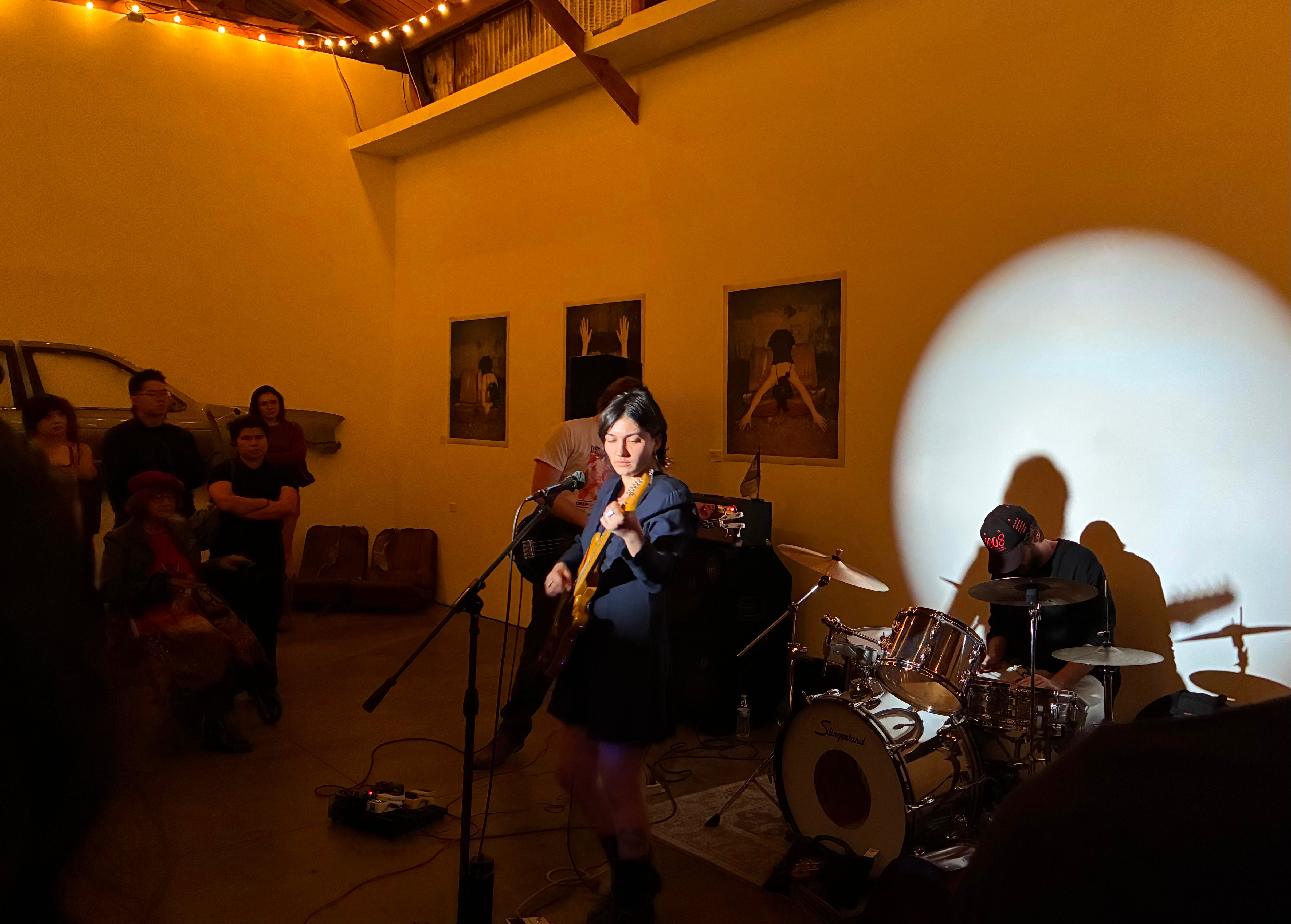
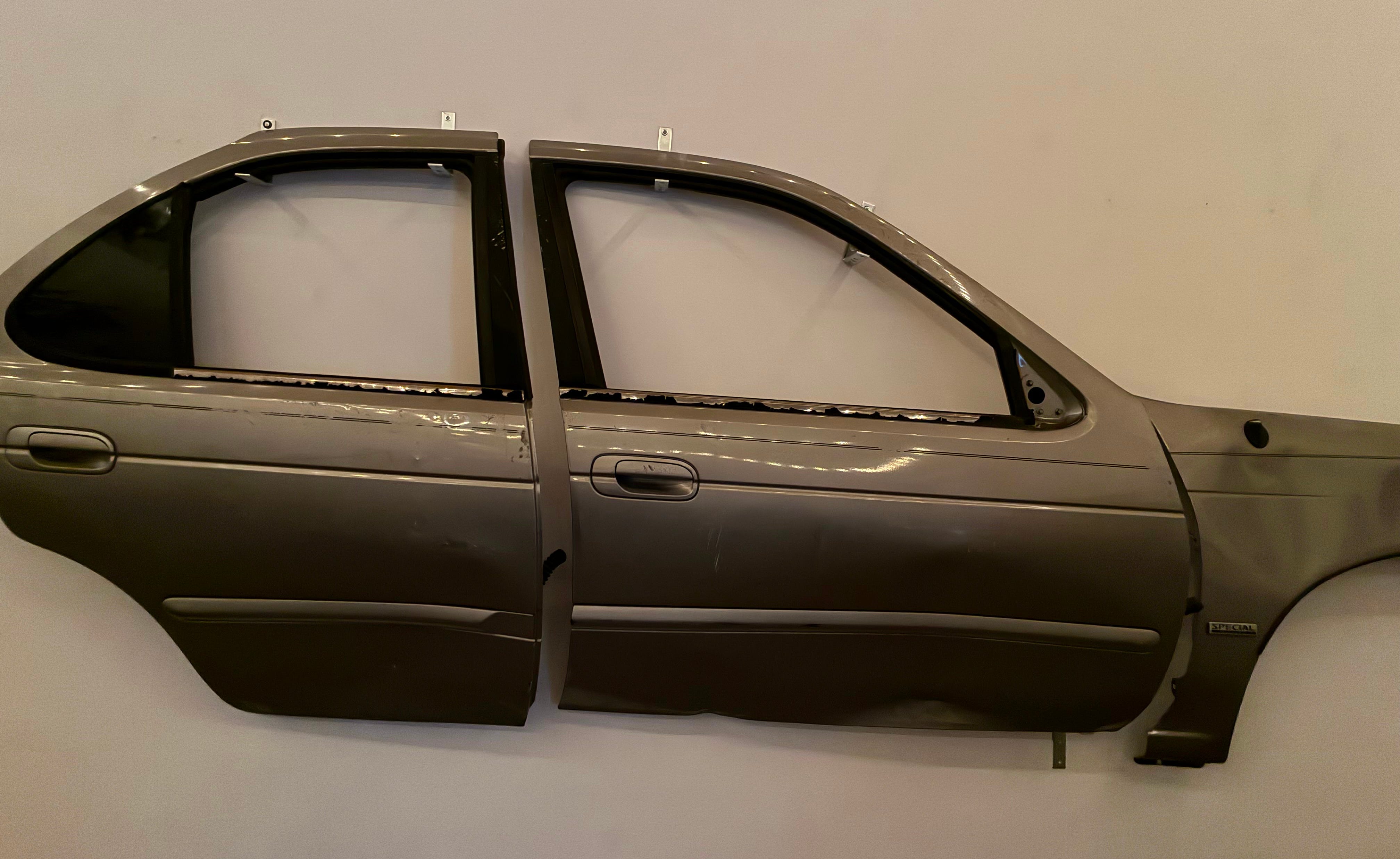
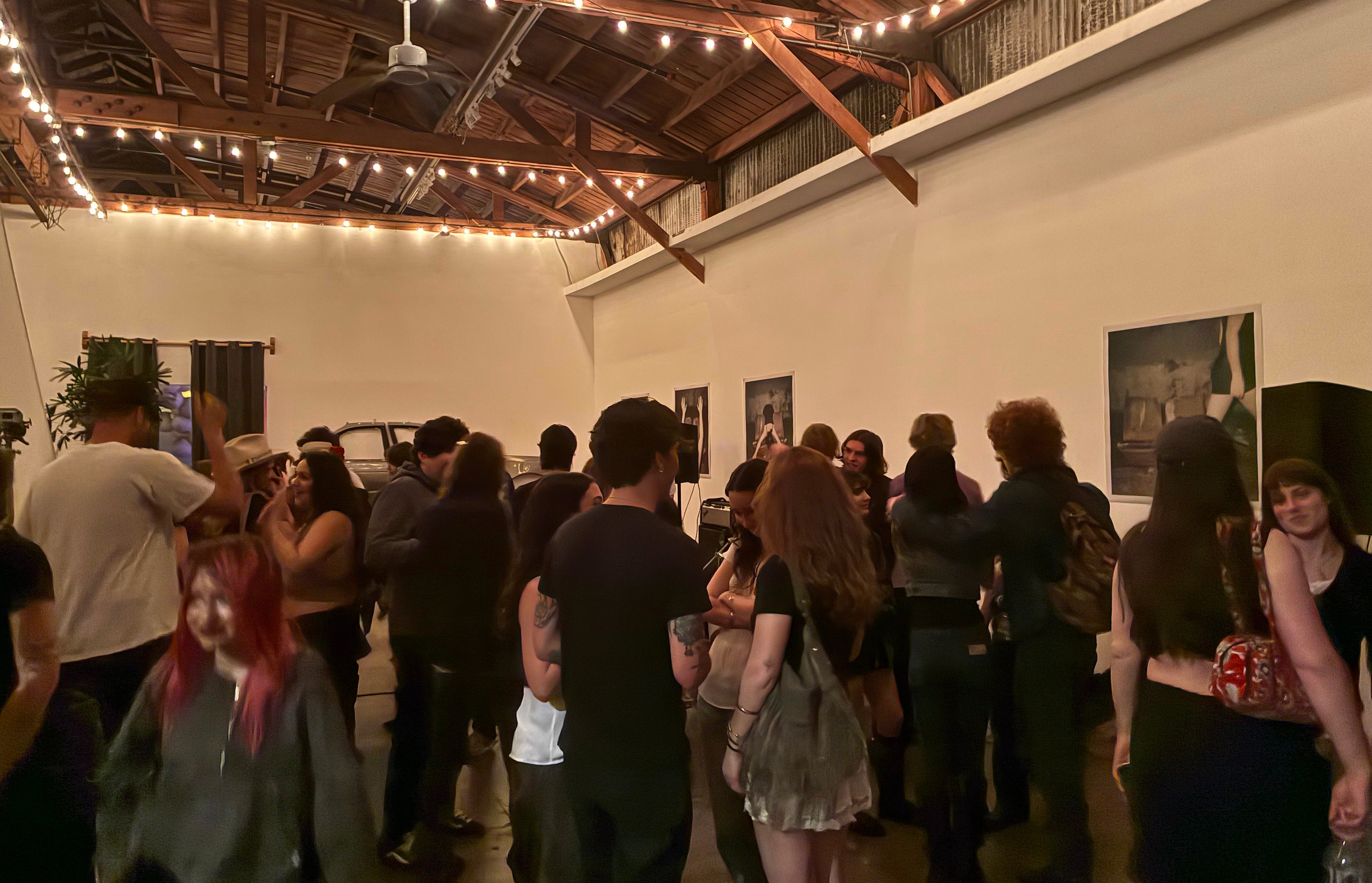
Sometimes when you see a concert you catch a glimpse of the future. Not in the giant, world-altering sense of religious prophecy, but rather the small, microcosmic meaningfulness of watching a band that has maybe a few hundred fans today and knowing they’ll have several thousand down the road. This is what happened to me a month ago when I pulled up to downtown LA art gallery Lonestar Studios to catch the premiere of a new music video by local hard rock four-piece Girljockey. Arriving just after doors, I walked down a short but wide dead-end alley and came to a two-story-tall garage door that opened onto a high-vaulted hangar about the size of a New York City two-bedroom. Twenty-year-olds sporting threadbare white tees, sleeves of tattoos, and jet black shag haircuts milled about the entrance, smoking cigarettes, while inside people chatted in groups of four or five, bathed in a warm amber light. Upon handing over my ticket and crossing the threshold, I made my way to the back of the space where a pair of beat-up car doors hung on the wall. On the ground to their immediate right were a couple of old bucket seats with parts of the upholstery ripped away to reveal the dull yellow stuffing underneath. After taking these objects in, my eyes continued their journey clockwise, where I was then confronted by a series of four large photo prints of Girljockey’s lead singer, Gillian Chamberlin, striking various poses with the aforementioned seats in a short black dress against the backdrop of what looked to be a burned-out cellar.
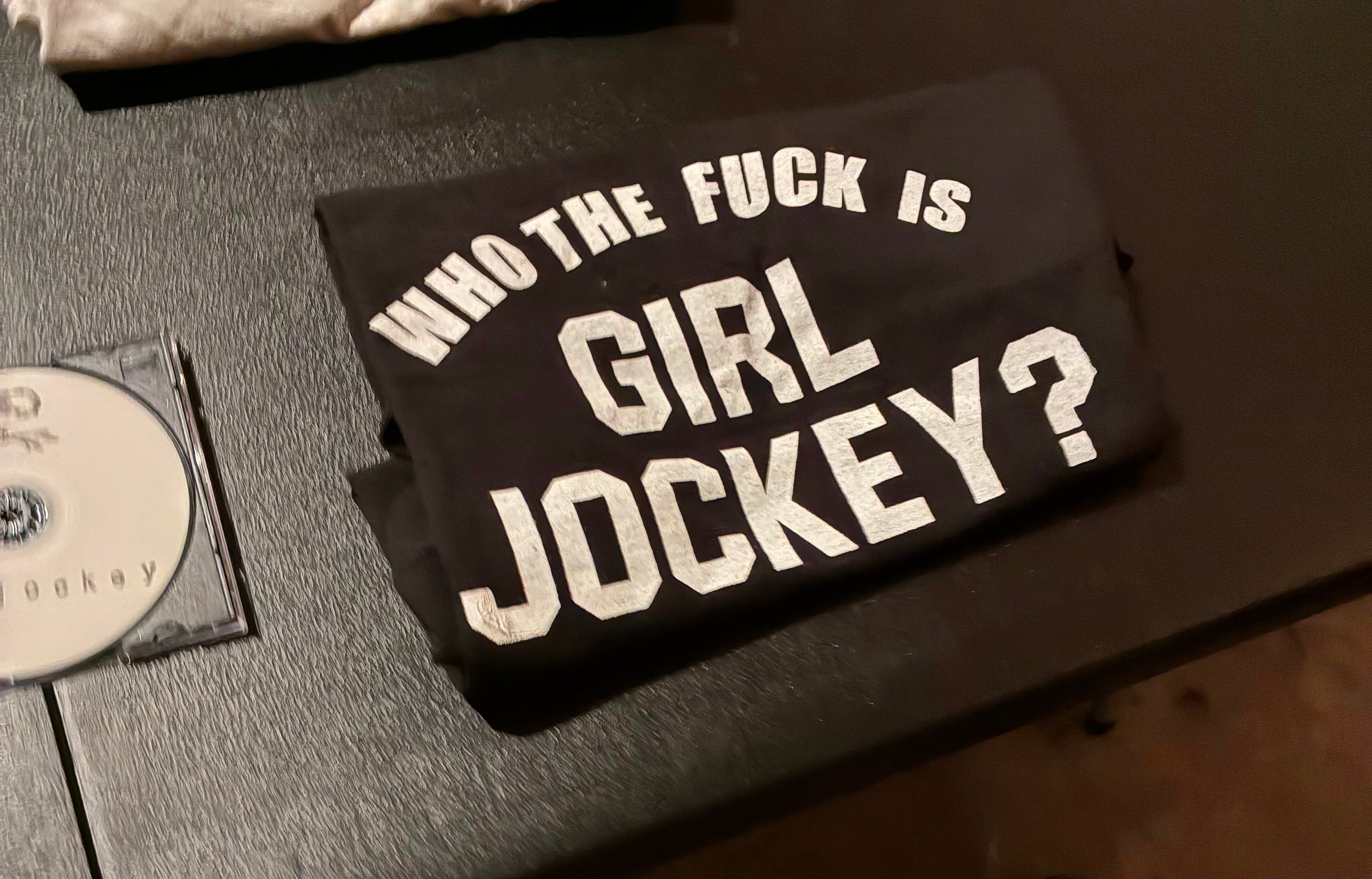
Normally, I’m pretty underwhelmed by the whole art show plus live concert concept, an idea good in theory but rarely executed in a way that elevates any of the parties involved. Here, though, my mind travelled immediately to Girljockey’s music as these objects carried the same desolate, scorched Earth quality that animates the band’s songs. Girljockey is comprised of guitarist and vocalist Chamberlin, guitarist Jackson Vann, bassist Sage Roth-Berg, and drummer Johnny Yanucci. They independently released their self-titled debut in August of last year, and its raw power and brutality ripped me from my seat upon first listen. A meditation on desire and the uninhibited beast that lives within, the album tells the story of a forgotten Southwest populated by characters of questionable morality, men who act without thought, and women who want without heed. While its barren landscape may hearken back to simpler times, the dead-eyed ambivalence towards consequence feels right at home amid the shameless opportunism and social atomization of our crumbling American empire. This is a heavy record, but not one that wallops you with walls of sound; it trades in distortion for cutthroat clarity as guitars crackle and pop like sets of gnashing teeth, and drum hits slap with a nakedness that would make Steve Albini proud. Speaking of Albini, the simple violence of Girljockey reminds me of that found on Slint’s Tweaz, only Slint never had a vocalist like Chamberlin; ultimately, it’s her murderous baritone that drones, wails, and screams these images into being.
Girljockey took the “stage” (a half-moon section of the gallery floor) just past 9 and opened with a dour étude played by Chamberlin on an upright bass that looked about 100 years old. After this, they played four or five songs, most of them new, before setting down their instruments and cutting the lights to let the new video for album cut “I Want” play. The transition was seamless, or at least appeared so to me. The sound from their last track lingered in the air for a moment and eventually mixed with a pre-recorded audio piece that then slid directly into the video. There was never a moment when the performance felt like it had stopped, same goes for when the video ended and the band reassumed their positions to play the final few songs on their set list. The incisive vision and attention to detail of the whole night gave me the impression of a group that knows what it wants, and it’s this quality more than any other that sets great art apart from good. Upon leaving the show, I knew what I wanted too, which was to speak with the band. A few Saturdays ago we gathered over video call and braved through technical difficulties to talk about their origins, their record, and how they pulled off that stunning live show.
Nick DeMasi: I found your record late last year and it really blew me away. How long have you guys been a band for?
Gillian Chamberlin: I think we’ve been a band for about two years? Maybe a little longer. The first real show we played was the Silver Lake Lounge in June of 2024, but we all met at Loyola Marymount University. I met Sage and Jackson through the radio station there, and I met Johnny through a poetry club. Then I dropped out of school with the intention of making the record.
How long after forming did the idea of a record come about?
GC: I made my first record when I was in high school. I started a band with this girl, and our friends’ dad was Mario Caldato Jr, who produced and engineered for the Beastie Boys. He was a super nice guy and offered to record an album for us because he liked our music. That album never came out due to some personal issues I had with the other band member, but afterwards, I remember thinking, “I’m going to make another album because I want to do this.” We were playing together for a few months before I pitched that I wanted to make an album and that I had been given the opportunity by another good family friend, Aníbal Kerpel, to record one for free. I pitched it as something I wanted to do and that we had to be really serious about, and they all were super into it.
Sage Roth-Berg: Even from the very first practices, the album was talked about, at least that’s what I remember. It was always the thing we were working towards. It was like “this album, this album, I don’t know when it’s going to happen, when it’s going to come out, but it’s a thing that’s going to come out.”
What was the writing process like for the record? Where did the songs come from?
GC: For most of the songs, except “SBS,” I would write something on guitar or bass and bring it to the band with something in mind for what I wanted. Then we would play through it and see what happened. “Kid Dynamite” took six months of playing and changing to get it to where it is now, and same with a lot of the other ones. It’s much easier to write now because everybody knows what parts to fill. I wanted this album to be a whole world, and it was really cool to try and explain that and have them fill it in in ways that I couldn’t even expect. But for “SBS,” Sage wrote the bass part, and then I wrote the vocals, and everybody else did their thing. Also, my dad’s a drummer, and sometimes I would have him be my demo drummer. On “I Want,” I had my dad play the drums that we recorded because I thought it would be cool to have him on the album.
Johnny Yanucci: Yeah, it’s always helpful when Gillian has the demo and her Dad is playing, because then I’m like, “All right, I know what she wants,” so I just figure it out based on that.
You said you guys are still writing now, and that the dynamic has changed a little bit to where the process is more collective. Did I hear that correctly?
GC: I think it’s similar where I’ll bring something that’s pretty fleshed out, but now, instead of spending six months trying to get the song to where it needs to be, it takes us maybe a month or two.
Gotcha. So the timelines have sped up because you’re more familiar with each other now.
Jackson Vann: Kind of, yeah. I also wanted to add that Gillian has—[Jackson freezes]
SR: Oh boy.
[Collective laughter]
SR: I think what Jackson was gonna say is Gillian is a musical force to be reckoned with.
GC: I also don’t know any chords. I don’t know what the chords are called. I barely know what the strings are called. I don’t know what my guitar is called. I don’t know what my amp is called. I don’t even play with an E string because it fell off, and I just don’t miss it. Technically, I don’t know what the fuck is going on, but in every other regard, I know exactly what I want going on.
[Jackson unfreezes]
One of the strongest aspects of the record is just how much of a world it is. Can you talk about some of the things that you wanted to populate this world with?
GC: Once we finished the album, I had this idea that I wanted to make a book to release with it. I wanted to do that because I write from these different personas and I’ll know everything about their lives. I’ve always written poetry like that, so now my songwriting is like that. I imagine all these people are in the same place; they might all know each other, or coexist together, or walk by each other on the street. The more I listen to the songs, the more I’m informed about how they interact with one another. I wanted to give more context because, as much as I can talk about it and explain it, I can see it too. So I wanted to recreate artifacts from that world that weren’t real, but that I could make real through images, objects, and words. When I was making the book, I realized that the throughline was want, wanting at all costs, and wanting despite whatever fallout there could be. That’s something that I don’t really incorporate in my life; I’m a very controlled and responsible person, so it was very cathartic to be a crazy person in the music.
I wrote down the word “desire” as the overarching theme that crushes its way through the album. There’s also a very palpable sense of danger that is lurking underneath all these songs; they’re violent from both a musical perspective, and lyrically, there’s a lot of violent imagery as well. What’s the relationship between desire and danger? Is desire always a destructive force?
GC: I grew up listening to a lot of folk music and bluegrass, so I’m naturally drawn to making things feel allegorical and, most of all, simple. I think violence and desire, or wanting, are such huge concepts that when you say the right three words about those things, you can throw people into their own world of understanding. There’s something super simple about huge concepts like those that will never not be important. Also, there’s such confusion between the two, and that they must coexist, but I don’t think they can coexist. I don’t think that violence and love can coexist, period. I don’t think that’s real. But I think there’s this compulsion that comes with the two, something primal, which is why I write about it. And once again, these are all things that I don’t want; they’re things that I don’t think are good, but I do think there’s something informative about them.
Is that common to a lot of the art that you guys like? Do you look for stuff where the artist is coming into it with the intention of building a world for you to be in, versus being more diaristic about it?
GC: That’s funny you say that because really the only books I read are autobiographies. Autobiographies about hitchhikers, autobiographies about gay people, and war novels. I don’t like reading stuff that isn’t real. I like reading stuff that is real because I want my work to feel like an artifact. I want it to feel real.
Something else I noticed about the record is that the production is very dry. There’s not a ton of reverb; it’s just the brutality of the instruments front and center. What felt right about that approach?
GC: We come from a large screamo scene. A lot of the first good DIY shows I went to were screamo shows here in LA. I had this desire to be able to exist in that scene, even though that’s definitely not what we are. That has a huge impact on this album, because even though it’s very sophisticated and melodic, there’s also a lot of screaming, and it is heavy. We were also working with Aníbal Kerpel, who is mainly a producer for film compositions, and he works with people like Gustavo Santaolalla, who did the score for Brokeback Mountain—[Gillian freezes]
JV: Oh, fuck.
SR: Give her a sec.
JY: One thing I can say quickly is that even when we were stripping [the mixes] down more and more, there was always a concern of them being overproduced. Like, is there too much going on that prevents it from feeling like a live session that you’re listening to in album format?
SR: It’s something I still think about pretty often when I listen to these songs, so I’m happy your takeaway from the album was the opposite.
So you still listen back hearing some of the production choices that were made?
SR: Yeah, there are some moments where I’m like, “I wish that this was a little different,” but I think once you’re on mix four of a song, it’s kind of like, let’s get the ball rolling.
Yeah, mix fatigue or feedback fatigue, or whatever.
SR: Yeah. There were moments like that for all the songs. Some of them were really quick, like, first or second mix, but then there were other songs where we needed to get out of our heads and just finish them.
JV: Also, every single one of the songs on the album is a matter of us going in and recording our parts live. It was them three playing together at the same time, and then me overdubbing my part, but that was the only overdubbing done, except for maybe one or two vocals. That led to us knowing exactly what the songs consisted of, so any choices, as far as the mix goes, were going to stand out a lot, but you have to go in some direction with the mix, so it took us time to form what we wanted with Aníbal. There was a lot of learning that went on, and I feel like the more we worked with him, the more he understood us and the more we understood him.
[Gillian rejoins]
GC: I’m sure the guys already said a lot of what I was going to say. We recorded the album in two parts. The first five songs we recorded took four or five different mix rounds because I was coming from listening to songs that had been totally four-tracked or just sounded like shit. And Aníbal was coming off working all day mixing full orchestras for The Last of Us, and producing stuff for Argentinian pop stars, so it was definitely us meeting in the middle. And having everything be recorded on the best equipment, you can’t hide under the buzz from a microphone, you know? It was really cool to work with him because I had explained to him my whole idea for the album, and he fully understood, there was no gap in understanding between the two of us. I also never had to articulate myself in that way. I’d say something like, “It sounds too shiny,” where it’s like, okay, you need less high-end. Part of it was learning to use words like that. Then, for the second round of songs, those only went through two mixes, because at that point, after working so hard on the first five, he knew exactly what I wanted.
It’s interesting to hear that your backgrounds are in the screamo scene. Could you talk a bit more about those connections? Because the music on this record is quite different from screamo.
GC: The hardcore screamo scene in LA is very small, and you’re in very close proximity to everybody. When I started going to really good shows, it was seeing vs self play, or knumears, or Train Breaks Down. We’re good friends with a lot of those projects, so they end up being around.
SR: Personally, I’m not a big screamo fan. I would never throw a screamo song on in the car, but I do really like being present at a screamo show and observing the way the band interacts with the audience; it’s one of the most raw musical experiences you’re going to see. The thing I appreciate is the passion; you can feel every drop of emotion and it’s pretty mesmerizing in that way.
Do you take inspiration from that when it comes to your live show?
GC: Definitely. When I’m playing live, I like to look at people, especially people I don’t know. A few years ago I saw Shame perform at Pappy & Harriet’s. I’ve never seen somebody interact with a crowd the way that Charlie [Steen] did. He walked on stage and looked every single person in the eyes; it was very clear that we were sharing a space and every barrier could be broken. A lot of the beauty of live music is that there isn’t a barrier, especially at smaller shows, we’re all just there. Art and music are so awesome because you can push so many thresholds with people. When I play, I look at the song through the conviction of the person that I’m singing about, or that I’m singing through. What does this person in this song want me to convey? I’m trying to get you to understand, and my life depends on it, so I’m gonna look at you.
I remember at the Lonestar show, everyone was giving you five or six feet of space, but then Gillian waved everybody up, and then we were standing right next to you guys as you played. I had never seen someone inviting that level of closeness while they performed; it was sick.
GC: Thanks.
Something else that blew me away about that show was how seamlessly you transitioned from the live performance into the music video and back. How much preparation went into that?
GC: It took so much preparation,
SR: But also none at all, in a weird way.
GC: That’s true. I put so much work into that video. We filmed it in November, the weekend before we played the Roxy. I dropped out of film school so I wouldn’t have to make films; it stresses me out so bad. Music feels so natural, but filming is anxiety-inducing; it’s so horrible. But I also love it because I’m intrigued by the final product. So the video was made, a bunch of people helped me make it, and then I was like, “Well, we need to have a big premiere show.” I can’t just be like, link on YouTube, you know? Then I thought, what is the kind of space and the kind of performance that can be of complete service to the video? I wanted a space where I could project the video, but what’s the point of playing a set and then playing the video? That’s two separate things. I wanted the whole night to be one experience that orbits around the video; I wanted everything to give you further context. That’s why we had the car in there. I wanted you to see the car, I wanted you to understand how big the doors were. The images on the walls were Polaroids my friend Daniel took of me. I broke down the song into four sections: the first was fixation, the second was surrender, the third was possession, and the fourth was expedition. I wanted to create self-portraits that represented those themes, and those were the four portraits on the wall. As far as the set, almost all those songs were new songs because I didn’t think playing our old stuff would do the night justice. I wrote the stand-up bass song that we opened with two or three days before, and after I played it for the guys, they were like, “Gillian, it’s really cool. It sounds just like ‘I Want,’” and I was like, “That’s the point! It’s paying homage, we’re opening the door for the whole thing.” And I wanted a live transition into the video, so I asked my friend Peter Molaro to make an interlude that we could play after the final hit of “KD.” The whole point of that release was to be super dramatic. There were four different people pushing play, and start, and stop for that video, but we hadn’t even fully practiced the transition. The projector was set up there 15 minutes before doors. It was crazy.
I love that about wanting the car doors in there so you could feel the size of the vehicle. How did you even get the car? And did you take it apart?
GC: No, I went to a car wreckage lot. The first one tried to sell me a single door for $100. This guy was sitting on a chair outside as I was leaving, and he asked, “Did you find anything?” and I was like, “No, too expensive.” He said, “Try that driveway,” and I pulled in and saw the perfect car. There was a guy already taking it apart, so I asked him how much for the doors, and he said 25 each. But now I just have these doors I don’t really know what to do with.
And then what about the car in the video?
GC: I rented that off of a drive share site. It’s a 1988 Chevrolet Corsica. I did not know how rare those cars are. You will not be able to find one anywhere. Unfortunately, my DP broke something in the car when we were filming, so I had to pay the insurance cost on the car, which was twice what the car cost to rent. I originally wanted to have the car in the space, but after that happened, no way in hell was I ever talking to that guy ever again. I felt bad and was also scarred from the experience because it was so stressful and cost so much money. So I got the next best thing, which was doors.
You guys obviously are still writing. Where are you guys at right now in terms of next steps for the band?
GC: We’re working on an EP. I’m hoping we can record that by the end of the year and get it released at the start of next year. We’ve had a lot of conversations about what’s next for us. It’s interesting coming from a DIY scene, the die-hard nature of being DIY, and the pride in that. But I still don’t know what scene we fit into. Something I want us to do is create more events like the music video premiere, full, all-encompassing experiences. We’ve already played with a lot of the bands in LA that I really wanted to play with, and I’m down to play with them again, of course, but I want us to continue to grow and change just like how we grew and changed over the last year. I want us to keep figuring out alternative spaces that our music can exist in. It’s interesting to have a project at this size because we’re super small, not that many people know about us, but being in LA gives you the privilege of reaching the right people. It’s cool to be surrounded by people doing really amazing, really interesting things, because it’s inspiring. And I, of course, want us to tour eventually. I want us to open for bands that are touring. We opened for she’s green a few days ago, which was awesome, because the audience had never heard of us, they had no idea what they were in for. This next year, I want us to have an identity as a project that’s so strong that it doesn’t matter who we’re playing with because it’s all there.
Big Tent Music is a project-based record label and music blog. Its name comes from the poli-sci term for a party that accommodates a wide range of beliefs.