


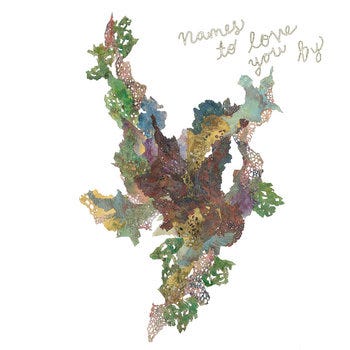
Something I do to waste time every once in a while is scroll through old drafts on my laptop and imagine what they might turn into if I were to actually finish them. I suppose it’s an experience common to most people who make things; there’s a repository of stuff that gets started and then just sits there, perhaps to be picked up once more, perhaps to be forgotten forever. The question of why some things see the light of day and others do not is ultimately one of identity; the person does not relate to it strongly enough to continue. This runs counter to typical conceptualization of art making as trying to crack the piece, but I think it’s borne out as truth by the fascination we have as an audience with those unreleased works that do end up seeing the light of day. How easy it is for us to love them and ask “Well, why wasn’t this enough?”
Names To Love You By (vol. 1), the debut compilation from the newly formed queer, San Francisco record label of the same name, aims to be a space that can cater to these shadow personalities, the parts of ourselves we don’t quite know what to do with yet and so keep under wraps. Composed of works-in-progress from 23 different musicians, including Chicago R&B beatnik Sen Morimoto, Oakland freak folk singer Maria BC, and Philly poptronica artist blue toed, the record flies through a wide range of styles while still managing to sound remarkably cohesive. Whether it’s a harsh looping post-jazz track a la “I Need the Bag (v1),” or an ambient collage of vocoder gurgles and microelectronic blips as on “200 Attention,” everything sits suspended in the same weightless ether; a liminal zone of positive possibility and open-ended experimentation capable of accommodating transmissions from behind the curtain.
The obvious care and attention that went into the construction of this compilation is a reflection of how the label’s founder, Kashika Kollaikal, who also makes music as Flung and as a member of the duo Honey Oat with Gabe Stout, is approaching the new endeavor. Speaking via video call this past Labor Day, I was struck by her ability to simultaneously hold such a clear vision for what she is attempting to build while also remaining open to the, in her own words, “foreverness of change” that is part and parcel to artistry. Names To Love You By (vol. 1) is out tomorrow, September 24, and I look forward to hearing more from the label in the future. My conversation with Kashika is below.
Nick DeMasi: I was really struck by how warm and inviting this compilation is, which I feel like maybe comes from the fact that these tracks are unfinished. Why the decision to focus on that for the first release of this new label?
Kashika Kollaikal: I talk about this as a love letter to imperfection, or what exists beyond the edges of what we might consider complete. As artists, we’re always in process, and there are spaces to showcase the final things that we make, but there are far fewer places to showcase the marks of process, or something coming into being. I was really interested in centering the label in this reference to different versions of our artistic selves with all our imperfections. Every musician I know has a hard drive full of songs. Like, Stevie Wonder made 100-plus other songs for Songs in the Key of Life that never saw the light of day.
I know deluxe editions or reissues of famous albums will typically include demos and things like that. Are you someone who’s trolling through all of that stuff?
Yeah, it’s always so fascinating. You always hear where a song ended up, but then if you listen to earlier versions, you can hear the little traces that turned into what we’re used to. I also love when artists do different versions of the same song in their discography. I do this a lot in my work, and I’m inspired by Milton Nascimento, who does this a lot. What does it mean for a melody or a chord structure to move with you? To not have it be fixed in time, but live as a testament to the foreverness of change?
Is there something you gain from being able to hear those inklings of an idea and trace how they transform? Does that do anything for you as an artist or as a listener?
I think there’s a fluidity to it. It’s like “Okay, no idea is ever fully bad or useless.” A thing that I made when I was 16 that I’m embarrassed to listen to and would never play for anyone; maybe there’s something about it that I really like and I could sample it or make a new version. You’re able to be in dialog with these past versions of yourself and hold everything that you make as having some truth to it, even if it’s not the full truth of your current self. There’s a podcast where Björk is talking about all of her albums and how they all have different characters, and each character was exactly right for its time. It really excites me to be able to release my fixation on completion. When I play stuff live, I totally release any impulse I have to make it sound like the recording. I just take some tiny little seed and play around with it, and then it’ll grow into another song entirely. It’s a cool way to be forever inspired.
Has that made it easier to release things? Viewing them as snapshots in time rather than definitive representations of yourself? Does that help with the anxiety of perfectionism?
It’s definitely still a work in progress, and I think this label is part of that work. Before, I was more concerned with certain benchmarks. Like, I wanted to press vinyl, and I wanted to have the approval of a bigger record label. There are, of course, still opportunities that I would like to have as an artist, but I think with starting this label, what I most care about is putting things out in a way that feels aligned with my values and my sense of community. I’m still trying to release the part of me that’s like “Everything I make must be a monument.” I still have some of that. I think we all have some of that. It’s so vulnerable to share work, but I’m really inspired by people who just make stuff and throw it up on SoundCloud, or Bandcamp, or whatever. I’m trying to move in that direction, and I think this label is part of moving in that direction.
Why did you think that starting a label was the right way to go about getting there? And then more generally, why did you want to start Names To Love You By?
Starting a label is something I’ve wanted to do for at least a decade. I’ve always loved curating and putting things together that feel disparate. I threw house shows when I was in high school and college with interesting bills. I think it’s fun and exciting to put things in conversation with one another. And then as an artist, I’ve worked with different labels and have had mixed experiences. I’ve had some really amazing experiences that I want other people to be able to have, and then I’ve had some experiences that made me feel like my vision or my identity wasn’t fully valued. I think of it as cultural organizing. How do I help create more space for my communities to put things out and get their feet wet? I also really love logistics and organization, and I know for a lot of us creative people, that’s not necessarily our favorite thing to do. So I’m happy to lend a hand. It’s really exciting to partner with an artist and support their vision.
From a label function standpoint, what are some of those principles that you want to bring to Names To Love You By? What do you think makes a good collaboration between an artist and a label?
The first label I ever released music on was Astro Nautico. I put out a Honey Oat record, which is a duo I’m in, with them in 2019, and a couple of things were so magical about that. One was that we had been obsessed with their output for years. They put out the first L’Rain record, they put out a Jon Bap record, they put out a Tatiana Heuman record. It was one of those labels where, if I got an email from them about a new release, I would check it out. As a listener, I think it’s really special to have a trusted source like that, especially as we get more and more shit shoved down our throats by algorithms and Spotify and AI. It was also special as an artist to step into a place where I knew so many people would listen to our music when it got put out because so many people trusted Astro. It also put us in conversation with some of their other artists. Some of those folks did remixes for us, or we played shows with them. The sense of artistic community was so strong. I also really appreciated a label I worked with called Citrus City, which no longer exists. They were a small DIY tape label, and I put out the first two Flung records with them. It was fully a passion project: no signing contracts, no one else owning your masters; Manny would just make 100 tapes and give the artist half of them to sell and sell the other half on Citrus City’s site. I think that’s the model I’m going to try to start Names To Love You By with. It just puts artists at the core. Someone asked me if I would want to do Names To Love You By full time, and I’m like, “Hell no.” I have so little interest in that because I don’t want to think about releases in terms of, “Is this going to be profitable enough for X, Y, and Z?” I’d rather keep it very small-scale and low-cost and not have to think transactionally like that. The last thing that’s important to me is honoring how artists want to present their work and identities. A big part of why I wanted to start this label is because how many labels are run by trans women of color? I can think of one off the top of my head.
That’s more than I can even think of.
It’s called Trans Music Archive in New York. They’re awesome, but they don’t even call themselves a label; they’re a nonprofit. There are so few, and I think that’s really dispiriting because it creates space for other labels to come in and act progressive and release all these things to help their image. But how are they treating the artists? How’s the communication? Are they just dropping a trans-woman-led band at the first sign of controversy with no explanation? These are all things I’ve observed, and they’re very frustrating to see. It can feel tokenizing at times, and so can the ways that it’s discussed in PR and things like that. I really want to be able to help artists through that and be a partner in their development. It’s not like I have a ton of commercial success or anything, but I’ve done a couple releases, and I’ve worked with some labels, so I have at least a little bit of knowledge and insight that I can help pass on, especially to younger musicians or folks who have less experience with some of these aspects of releasing music.
How did you go about bringing together the artists for this compilation?
There was a big batch of people that I emailed literally three days after I decided to start the label. That’s just how I am; once I have an idea that I’m committed to it, I’m like “Go go go.” I wrote to probably 20 artists, and maybe half of them are on this compilation. Then I reached out to other people as well, some from when I was a kid, some from college, some from doing tours, or playing shows together. There were also a few people who I found through the internet and just reached out, being like, “Hey, I’m doing this thing, and if it sounds interesting to you, I’d love for you to have a song on it.” There are musicians from three different continents on this compilation. Obviously, there’s North America with the US, including some folks in Canada, and then Emma sent in a track from Germany, Maxine’s track is from New Zealand, and Sui Zhen’s track is from Australia. It’s cool to have these different corners of the globe represented.
It also sounds like when you made this list, there wasn’t a concrete sound that you were looking for. It was more shooting from the hip, just going on intuition basically.
Yeah, it’s very rooted in intuition. I don’t even know what connects everything, but it’s like when you play a cello, or any string instrument, and you get one string in tune with another string, you get a sympathetic vibration. Similarly, if you put works in proximity to each other, you hear interesting connections between them. It was really fun sequencing this; I had such a blast figuring out how to hold someone’s hand and be a tour guide through this compilation that goes to so many different places.
What do you think is gained from moving intuitively? What does that provide versus deciding beforehand what something should sound like or what you’re trying to evoke?
I think it’s the mystery of it. I didn’t say no to anyone. Once people sent me something, it went on. There were a couple of people who sent me a few things and said, “Choose the one that fits the best,” but I mostly just trusted that whatever the artist needed to release, they needed to release. It’s about relinquishing control. And, I don’t know, I’ve never started a record label before, so the whole project feels very rooted in intuition and figuring things out as I go.
How do you envision queerness showing up in the label? Is it primarily from an identity perspective? Are you only going to spotlight queer artists? Or is there queerness in the music itself that you’re trying to highlight?
It’s a great question and one I’ve given a lot of thought to. Yes, there is a component that is identity-based. I want to primarily release work by queer people, trans people, and people of color. That is important to me because those are identities that I share, and those are people who don’t always have the same opportunities for release. Or if they do, there’s tokenization, like I was saying earlier. And it’s important to me that I, as a trans woman of color, am doing this because if more of us did, the music infrastructure would be better for it. Though at the same time, I don’t want to put up hard boundaries around those identities. Identity is so fluid, and I’m not trying to litmus test people. If I feel something in your music, then, I don’t know, there’s something queer in it. There’s something culturally or ethically queer that I’m connecting with, and I don’t need to ask you, “Oh, are you queer?” Like, for what? People’s identities shift all the time, and I want the door to be open in that way rather than closed. So I’m not limiting it to only queer artists. I’m not talking about it in that way, and I don’t even think that’s the case on the compilation. It’s okay not to know. I like not knowing. I’m not entitled to anyone’s complicated thoughts on gender and sexuality unless they want to share them. To your other question, I definitely think there is something very queer about the whole label ethos and how I’m thinking about community, and imperfection, and loving different versions of ourselves. My transness has taught me so much of that by necessity.
What about the name of the label? Where does that come from?
On my record Apricot Angel, there was a track called “Names To Love You By.” I came up with the track title around when I was changing my name. One of the things I was thinking about a lot was like, “This will probably be my last name, but also maybe it won’t.” Maybe I’ll change my name again, and that’s okay. We can all find lots of names to love each other by, and we’re better off for it. That’s not a deficit. I have so many trans friends where you meet them six months later, and they have a different name, and it’s just like, “Great! More names to love you by.” I also had a radio show on Lower Grand for a couple of years called Names To Love You By. It’s cool to have this phrase that has traveled with me through different types of projects.
What’s in a name?
I think history and memory are often in a name. So are agency and self-determination. When I think about the choosing of names in trans communities, it’s such a claiming of space and identity and being able to decide who you are and how you want to be known to the world. There’s a creativity to that. And beauty too. Names can just sound nice, you know? They roll off the tongue in a nice way. There’s also silliness and fun. I have a big nickname family. One of my dear friends who recently passed away was such a nickname guy. It can hold so much. A name can really hold worlds.