


I struggle to understand the appeal of the modern-day mega festival. Their posters stand as giant false promises, seas of names artfully selected so that a variety of target demographics will recognize at least 20% of them and can thereby be convinced that the $600 ticket price is actually a good deal. When the schedule finally drops, however, it turns out that everyone you hoped to see plays at the same time as each other, forcing you to either choose between them or hop between tents, which are always impossibly far from one another, and miss good portions of each set. From there you’re standing in crowds several hundred rows deep, catching glimpses of the tiny figures on stage but mainly just watching via the giant screens flanking them so that really the only difference between being there and watching the livestream is that now you get to do so while standing in a cloud of dust under the blaring heat (or worse, in a sea of mud under a torrential downpour). Not to mention you barely eat or drink anything all day because the lines to the food trucks stretch miles long and queuing in one means missing at least one and a half sets, purely for the privilege of enjoying some incredibly over-salted and under-satisfying grub. The whole ordeal seems like a giant waste of time.
That being said, I do like the concept of a festival. I mean, if you love music, how could you not? A communal gathering organized around cramming as many live performances as possible into the span of a few days; a giant party in celebration of human creativity and self-expression. When done well, they can be transformative, spiritual even. My ideal festival experience looks something like this: a diverse bill with equal chance to satisfy and surprise, a schedule that makes it at least plausible to see every artist, multiple stages that are easy to traverse between and offer ample sight lines, reasonably priced tickets and food, at least one space to chill out away from the music for a second, and a 20:1 patron to toilet ratio (if not lower). By my count, this past April’s inaugural Open Melody festival here in LA checked almost every box.
Open Melody is the brain child of Sam Farzin, a Southern California-raised musician, graphic designer, and now festival organizer, who got his start booking shows while attending UC Irvine back in the early 10s. By Sam’s estimate, he helped book over 300 artists to perform at various DIY venues around campus and in the city; everything from legitimate auditoriums to lecture halls and lab annexes. The efforts were under the guise of a school club called Acrobatics Everywhere, which he started to gain access to funding and the university’s network of open spaces. He ran it for 5 years, and even stuck around after graduation to help his successors continue the endeavor, but eventually scaled back his efforts as life after college got rolling and other creative projects took precedence. The name Open Melody actually dates back to this time in Sam’s life when he threw two small festivals under the moniker in 2010 and 2011 as part of his work with the club.
Farzin first had the idea of throwing a “genreless” music festival in Los Angeles back in 2016. One of his main sources of inspiration was All Tomorrow’s Parties (ATP), a UK event series founded by promoter Barry Hogan which threw a string of unconventional musical “weekenders” at British holiday camps throughout the 00s, before succumbing to financial ruin in the early 10s. ATP lineups were curated by the headliners themselves, a list which includes the likes of Mogwai, Slint, and Autechre, and so often featured a wide variety of disparate bands and performers reflecting those artists’ idiosyncratic tastes. There were even a couple of ATP events in LA, one in 2002 at UCLA curated by Sonic Youth, and another in 2003 at The Queen Mary curated by Simpsons creator Matt Groening, but Sam never attended these. Instead, something he did go to was “Arthur Nights,” a four-night concert series thrown by the counter-cultural magazine Arthur at the pre-renovation Palace Theatre back in 2006. “I went to every night. I drove back and forth from Irvine, and I saw so much crazy shit. I saw the Sun Ra Arkestra play for the first time. I saw the ambient noise duo Yellow Swans. I saw Bert Jansch shortly before his passing.” According to him, “Arthur Nights” was the last event of its kind to take place in LA before Open Melody.
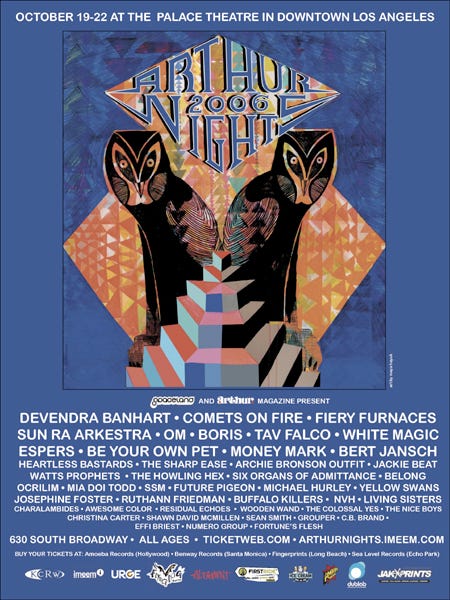
Memories of these eclectic journeys of musical discovery, and a general dissatisfaction with the narrow curatorial mindset of most contemporary Stateside festivals, fueled a desire to bring a similar style of no-holds-barred programming back to the City of Angels ten years later. At first, the dream came and went as his ambitions outstripped his capacity to execute. A second attempt in 2020 also failed (for obvious reasons), but the third time proved the charm. This finally realized iteration of Open Melody began in 2024 when Sam discovered and became obsessed with the repetitive drone band France. After learning that the group had never performed in the States, he sent an impromptu email inviting them to come play a yet-to-exist music festival in Los Angeles. The proudly hermetic duo tentatively accepted, which got him thinking about what other bands to book. From there, he set about reaching out to Japanese femme rock group OOIOO, New York industrial ambient band Growing, and experimental groove percussionists Tussle. Sam’s goal when booking was “to cover everything. To cover as much musical ground as possible. To make the lineup as diverse as possible in terms of who the people showing up to play were.” Pretty soon, he had a list of artists large enough to warrant locking down a space and setting a date.
My experience at Open Melody began when I pulled up to 2220 Arts + Archives in the late afternoon of Saturday, April 4. 2220 is a prominent indie venue in Los Angeles that typically books across avant-garde jazz, electronic, and classical music. I’ve seen everyone from Cakedog to Pink Siifu to Eliana Glass there. The space is split up into three main rooms, the first of which is a bar area with an elevated platform that is sometimes used as a stage for performers, though not for this festival. Behind the bar, through a hallway on the right, is the theater, a large, multi-use space with tiered seating in the back, a wide expanse of floor space, and then a stage at the opposite end. The third and final room is off to the left of the bar and is essentially just an empty warehouse space with two raised platforms in the middle accessible via stairs. One of the platforms was being used as some sort of storage space/festival organizer HQ, and the other hosted a mixing board and livestream setup.
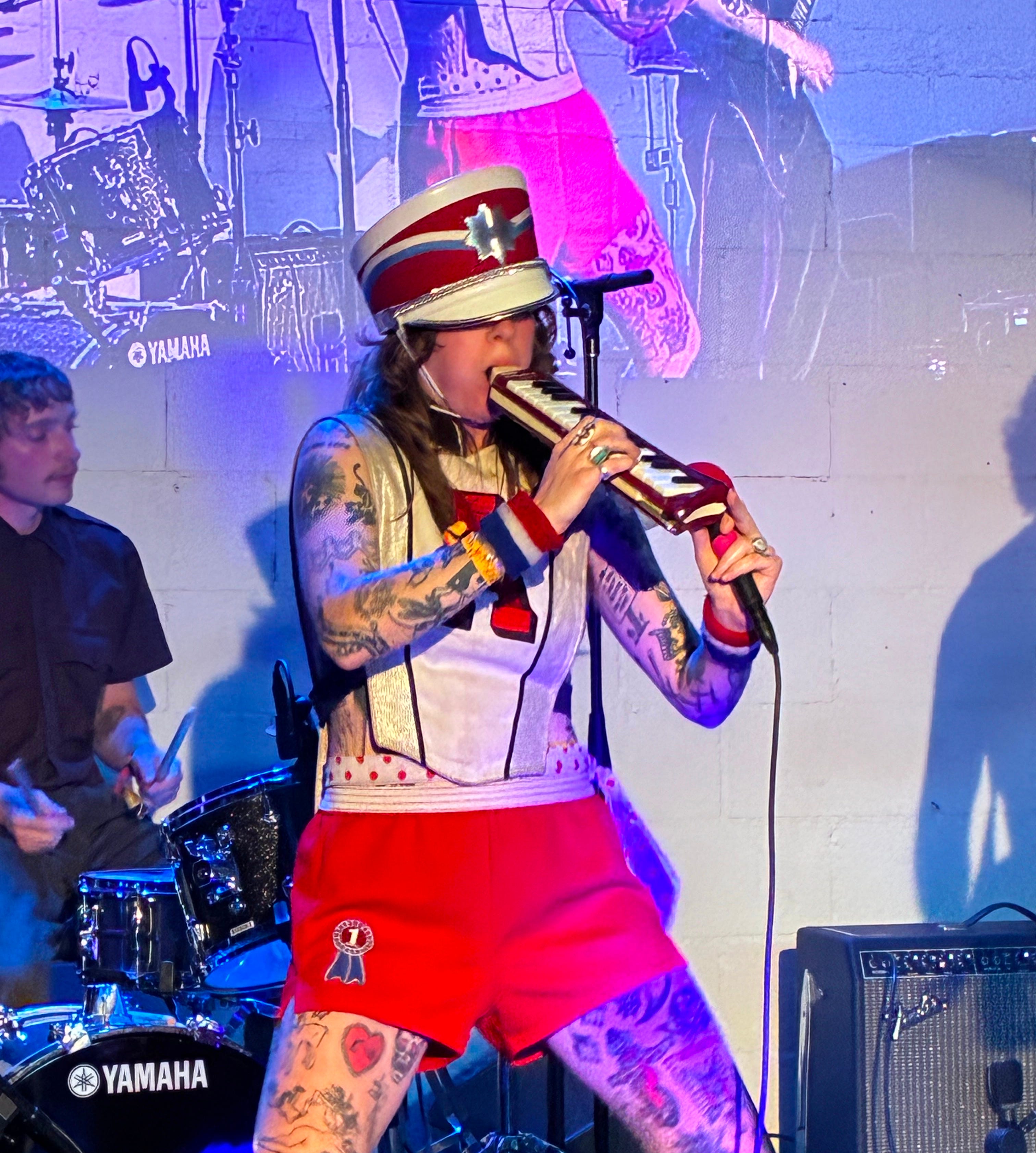
10 acts performed that day, one every hour from 3 PM to midnight. Sets alternated between the theater and warehouse spaces to allow for overages and more relaxed sound checks. Just before 5, I filed into the warehouse to see my first band of the day: Artificial Go, a squirrely 4-piece punk group hailing from Cincinnati. Lead singer Angie Willcutt strutted onstage in a deranged marching band outfit complete with a giant shako hat that kept falling over her eyes as she bounced around and shook her legs in wild abandon. The music was angular and primitive, evoking The B-52s crossed with The Velvet Underground. Willcutt’s round, baritone vocals even had an air of Nico to them. It wasn’t really my cup of tea, but their performance swept me away regardless, a common theme throughout the night. “Performance is more important to me than almost anything else when I see a band,” Farzin later told me. For Open Melody, he wanted artists who were truly going to make you feel like you had to be there to see them live; whose shows would give a new edge to their music, and expand people’s minds as a result.
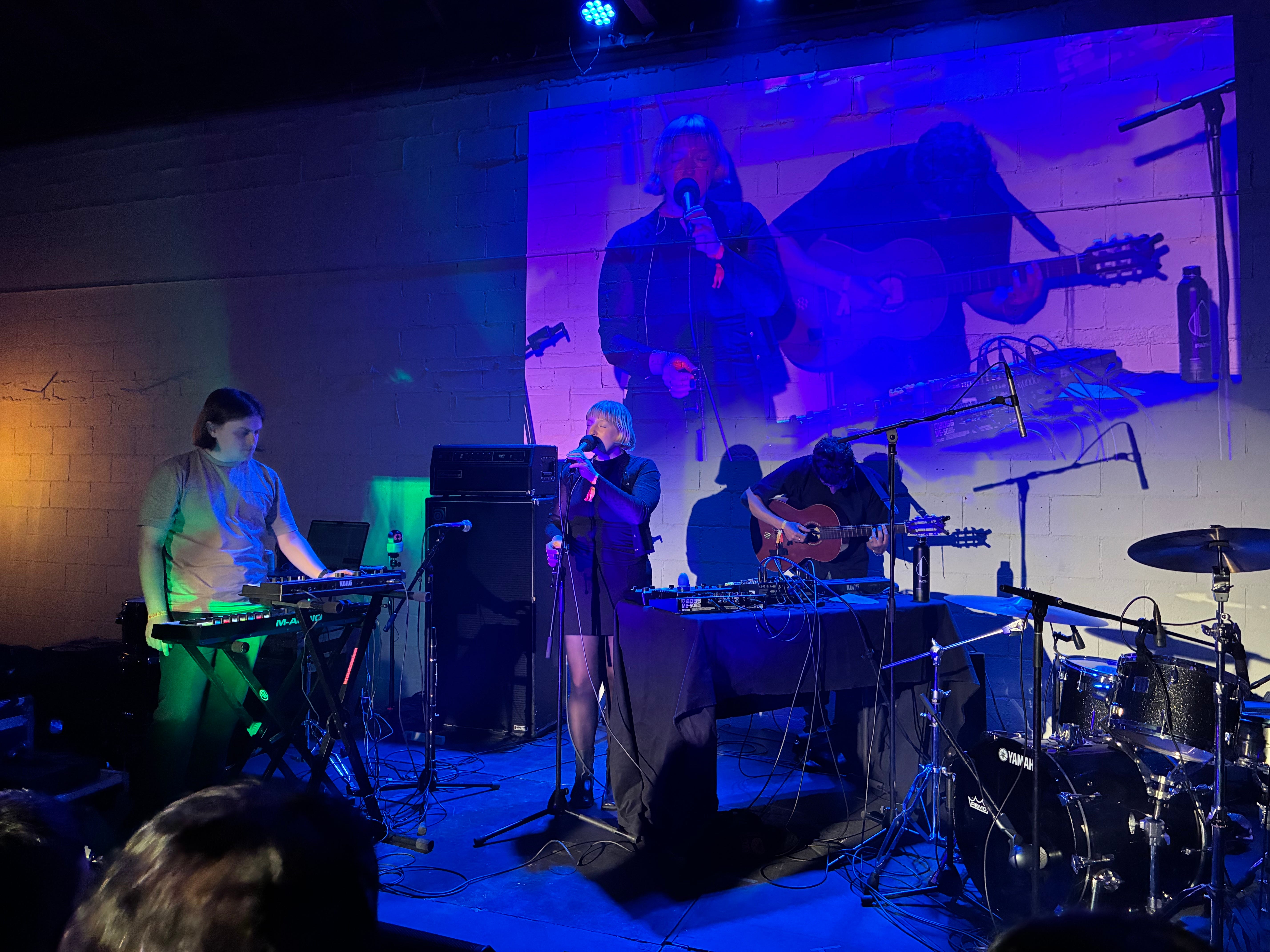
After Artificial Go wrapped up, I waited around the bar for a few minutes before entering the theater to catch New York trio Kassie Krut. This seamless movement from one set to the next is what I’m always hoping for when I go to a festival: that the breaks in the music be totally up to my discretion and not just circumstantial. I’d heard Kassie Krut’s music before and thought it was cool, but could only remember their track “Reckless,” where they spell the band’s name on the chorus. I later found out that two of the four members were also in the post-math rock band Palm, whom I caught a couple of times while at NYU in the late 10s. Suffice to say, I didn’t have many expectations heading into the set. The first thing that struck me about the band was that they had nothing resembling a traditional instrument onstage with them. Lead singer Eve Alpert stood at a microphone beside a small table that held a few black boxes with knobs poking out the tops. On her right sat drummer Matt Anderegg with a pad-only setup all the way down to the kick-drum, and on her left, Kasra Kurt stood behind another table filled with a mess of things, one of which I later realized was an electric guitar laid on its back, that he repeatedly smacked with a drumstick to produce shiny metallic clangs. Anderegg and Kurt wore black shades in the already dimly lit room, and the whole trio was nothing but business as they pummeled their way through what can only be described as cacophonic industrial club music. I had a huge smile on my face by the time the set ended and immediately looked around for someone to share my awe with, eventually finding a woman wearing the same goofy, joy-smacked grin as me.
Next up on the bill was the Bristol-based new age trip-hop group Tara Clerkin Trio, whose inclusion on the festival lineup was the main reason I had decided to attend in the first place. Open Melody hit my radar back in February when a friend sent the flyer to a group chat, noting the unhinged lineup, but decrying the $230 ticket price. $230 is a lot of money, and especially so, I imagine, for most people who are interested in the types of artists that were playing. Charging so much seemed a little prohibitive (and presumptuous) for an event taking place at a local indie venue where I was accustomed to catching shows for a tenth of the fee. But as the event got closer, the draw of Tara Clerkin, whose piano-minded EP In Spring I found during the pandemic and have loved ever since, proved too great to deny, and the $110 single-day pass not enough of a hurdle to stop me from ponying up the funds and going.
I think it’s important to briefly derail the narrative and engage in a discussion about “value” as it pertains to the cost of Open Melody. In spite of these ticket prices, the festival still lost money, and that is even after Farzin pulled several favors with longtime friends to manage technical operations, execute the livestream, and just generally chip in to make the thing a reality. I won’t deviate from my stance that $230 is a lot of money, but it is less than $600 some people paid for Coachella the following weekend, and though I didn’t attend that festival, I have no doubt it wasn’t nearly as enjoyable a pure musical experience as this was. In the course of 5 hours, I saw 5 artists who all blew me away in their own unique style, and if I had gone earlier and stayed for longer, that number probably would’ve been 10, which nets out to $11 per set. Seems fair, honestly. The truth is, it costs money to put on a well-executed event that pulls together so many ambitious artists from across the globe. We can talk about our dissatisfaction with the status quo and wanting more alternatives like Open Melody all we want, but those alternatives still require an investment, and with that a prioritization that we also have to be willing to give. This isn’t to guilt-trip anyone who balked at the price tag, as I myself did at first. I’m just wondering how we square the idea of accessibility with ethics.
Okay, diatribe over. Back in the warehouse, the Tara Clerkin Trio began without me even noticing, playing a warm-up of sorts that dovetailed right into the opening of their first song. This set the tone for the entire set, which was rather lowkey and reserved, but in a way that suited the band and their quiet blend of jazz, classical, and downtempo. The last traces of light were pouring in through the tinted windows behind me and bathed the band in a soft yellow glow. Everything felt very rhythmic; I recall swaying to Tara Clerkin’s voice as it oscillated around the room like the sound from a singing bowl. In fact, I recall the whole crowd swaying to the music, but I’m not sure if that’s true or not. None of the members spoke a word until the very end of the performance, when drummer Sunny Joe Paradisos stood up and made his way over to a drum machine, where he started to play around with some livelier hip-hop loops. He addressed the crowd and began egging himself on, making goofy faces as he made mistakes and found new beats to fiddle with. His bandmates looked on, smiling. These final moments felt the most intimate, like the band was peeling back the curtain and inviting us all into the studio with them for a moment.
After Tara Clerkin wrapped, I made my way outside to the patio area behind 2220 where a pair of food vendors were set up under pavilions. In my head, I made the decision to be late to the next set as I got in line to order noodles. Almost immediately after I paid, however, a man stepped out onto the steps leading back into the venue and announced that the next artist, Lubomyr Melnyk, had requested that there be no entries or exits while he played, so the event staff would be shutting the doors to the theater at 8:05. The groups around me began discussing whether they should go in or not. I sat at a picnic bench wondering the same. Eventually, the patio area started to thin, and soon I was one of the few people still outside. It was 8 by then, and my food wouldn’t be ready for at least another 15 minutes, so the time to act was now. I looked up Lubomyr on my phone and found that he was a Ukrainian pianist who had never played in Los Angeles before. The piano is my favorite instrument, and given how good the three sets before me were, I figured this was not to be missed. With the seconds ticking down, I sprinted from the patio to grab a seat in the theater, cold noodles be damned.
Inside, it felt like everyone else made the same decision as me because the space was packed. I found a spot on the floor not far from the exit and tucked myself in to watch. Melnyk calls his style of playing “continuous piano,” a technique he developed over decades of devotion to the instrument. The sound is as if several pairs of hands are playing at once, an incessant stream of overlapping notes that tumble forward like a mellifluous babbling brook. Melnyk’s small frame hovered inches from the keys, moving back-and-forth and up-and-down the instrument as his foot constantly worked the sustain pedal below. I was reminded of Celia Hollander’s album 2nd Draft, a piano album which has a similar style, but was made by meticulously splicing live improvisatory takes together in a DAW after the fact. Here was a small 77-year-old Ukrainian man doing it all in the flesh.
I looked around me at the crowd, taking note of how different people listened. Some sat with their eyes closed and heads back in reverie; others were hunched forward and staring, utterly transfixed by Melnyk’s figure as he played. I spotted some of the members of Artificial Go standing and watching the music on the opposite wall. For Farzin, seeing these Cincinnati punks get to know Melnyk’s music, and then later the man himself when they all encountered and befriended one another smoking in the courtyard after the show, was one of the highlights of his entire weekend. Speaking to the band the following day, he said they told him “how inspiring Melnyk’s set was, and how being able to play and then go see that was so special to them. It made me feel very good about all the curatorial, scheduling and pacing decisions I’d made.” There is a sort of musical alchemy that goes on behind the scenes at a festival like Open Melody, chance encounters that would’ve never happened otherwise and, down the road, create sounds never before heard. It’s like a magnified butterfly effect; a benevolent whirlwind that sweeps its participants up for a few days and spits them back out undetectably, but undeniably, changed. One can only speculate as to the force of combining such a wide range of sounds in a single space on a single weekend in April.
Melnyk played three pieces in total for just over an hour. In between each, he stood up and addressed the crowd for about 10 minutes. His second and final speech was an impassioned plea not to forget about the people of Ukraine in the midst of their existential war with Russia. Later at the merch table, I stood behind a woman who spoke to Melnyk for some time in broken English. “We have been waiting for you to play here for a long time,” she told him. Watching Melnyk play was moving for me because his voice behind the piano was so expressive and singular, but for this woman in front of me, the significance of the event ran much deeper. His set that evening was a connection of a sort, a lifeline cast out across time and space connecting her to him, and both to a homeland which was becoming harder and harder to access. I can’t admit ever having felt this type of connection with the arts; my makeup, white cis-het male from middle-class suburbia, doesn’t really allow for it. I’m deeply moved by music, of course, and there are specific songs and albums which hold rich, personal meaning for me, but this idea of connecting to something which was lost and being able to glimpse it again through the sound of a piano? That sits outside my reach. It was a reminder that the importance of bringing performers to new places goes beyond simply introducing people to new sounds, but in making accessible experiences of recognition which otherwise would not have occurred.
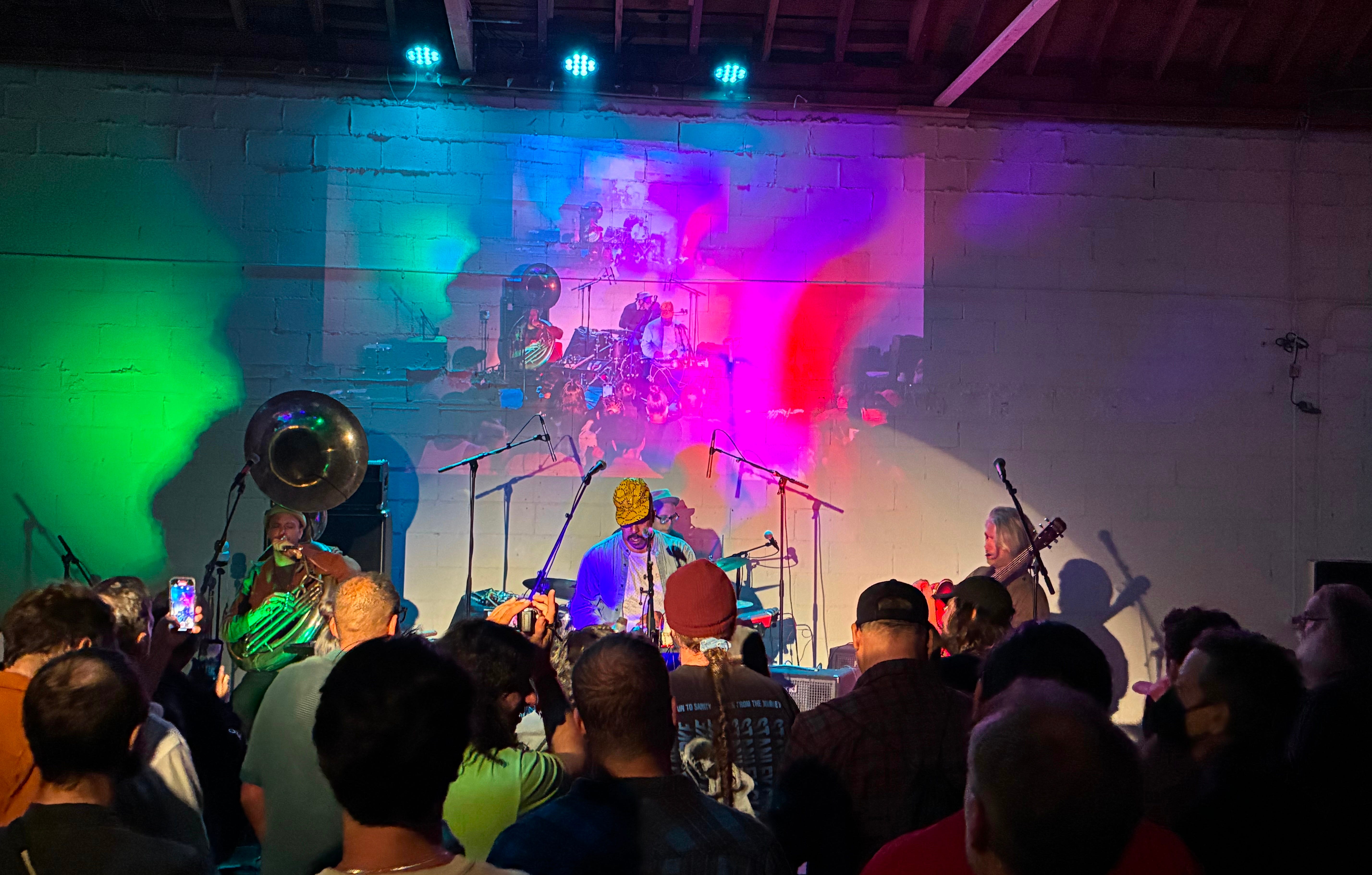
Back outside, my noodles had been ready for over 40 minutes. I sat on a picnic bench eating them cold and glommed together, but feeling satisfied all the same. After I finished, I headed back to the warehouse room to catch my final performance of the day: the Ben Lamar Gay Quartet. When I entered, the space was awash in bright red and yellow light and filled with the din of raucous whoops, horns, and tambourines. Lamar Gay stood up front in a five-panel hat that he kept taking on and off while intermittently singing, chanting, and screaming into a microphone. On stage with him were a tuba player, a keyboard player, and a drummer. Together, they played a style of frenetic and improvisational roots music that seemed to suck up everything from jazz to blues to hip-hop to tropicalia. It took me a few minutes to attune myself to their rhythm, but once I did, I found myself electrified by Gay’s uninhibited explorations, his willingness to change directions on what seemed like a whim and follow any idea to its absolute conclusion. The crowd around me was similarly swept up in the journey, and when the set finally came to an end, I felt a palpable exhale from the room as we all returned to normalcy.
I tried to stick around for OOIOO afterwards, but their 10 pm start time kept getting pushed back, and I unfortunately had somewhere to be early the following morning. It was a shame to have to leave, but I was comforted by how full I felt walking out into the blue LA night. My evening at Open Melody was by far one of the best musical experiences I’d had in some time. Without a desert, without massive LED screens, without a bill that ran 100 names long, the independently produced event had made good on the ultimate promise of the festival: a single day dedicated to nothing but bearing witness to the gift of live music. I’m already looking forward to next year’s.